
Thursday, December 12, 2013
Holiday Bazaar
Today my husband and I sold honey and candles at the annual Holiday Bazaar at my work. There was an amazing turnout, I nearly sold out of all of my 2013 honey! I do have a few jars left for anyone who is interested ;)


Tuesday, December 10, 2013
Freezing
BRRR! It has been extremely cold lately. Last year we had some cold snaps that finished off one of my hives in January. I'm a bit worried that this cold snap is going to freeze my weaker hives. Earlier this week it dropped to the high 20s, last night the temperature dropped to 30 degrees F. The water bucket I leave out for the bees was frozen. Mum dumped out the water for me and freshened it, here are the little sticks that I keep in the water to provide life rafts for the bees, frozen solid!
.JPG)
Luckily, there was activity in front of all three hives later in the day as it hit a high of 52 (even the weakest yellow hive):
.JPG)
.JPG)
Luckily, there was activity in front of all three hives later in the day as it hit a high of 52 (even the weakest yellow hive):
.JPG)
Sunday, October 20, 2013
Last Minute Checking
This is probably the last chance I'm going to get to check in on the bees this season. It's probably going to start getting chilly, it's barely reaching the mid 60s in the afternoon. If it gets much colder, it would be risky to open the hives.
I wanted to checkin on the yellow hive after my robbing disaster last month. Looks like the queen is still alive and well! I can't believe I found her again, I can rarely spot my unmarked queens. I usually have to look for other evidence that they are well (looking for eggs and young larve). Here is the yellow hive queen:

Though I found the queen, I also saw that the yellow hive has nearly cleared out their honey stash already! Rather than bringing in nectar, they seem to have just been eating the frames of honey I gave them last month. I was able to clear out 10 empty frames and reduce the hive to only two hive bodies. I also put on a feeder to try to help them through the winter... it's not looking good for this hive.
Even though the bees don't seem to be bringing in much nectar, there is certainly a lot of pollen is still coming in, check out this great shot of the bees carrying pollen:


I wanted to checkin on the yellow hive after my robbing disaster last month. Looks like the queen is still alive and well! I can't believe I found her again, I can rarely spot my unmarked queens. I usually have to look for other evidence that they are well (looking for eggs and young larve). Here is the yellow hive queen:

Though I found the queen, I also saw that the yellow hive has nearly cleared out their honey stash already! Rather than bringing in nectar, they seem to have just been eating the frames of honey I gave them last month. I was able to clear out 10 empty frames and reduce the hive to only two hive bodies. I also put on a feeder to try to help them through the winter... it's not looking good for this hive.
Even though the bees don't seem to be bringing in much nectar, there is certainly a lot of pollen is still coming in, check out this great shot of the bees carrying pollen:

While checking in on the hives, I found this ridiculous frame of honey! I must have forgotten to put foundation on a frame next to this one, because the bees just kept building it up. I have no idea how I'm going to harvest this:

Sunday, September 15, 2013
Cleaning Wax
Cleaning wax is not my favorite thing. I get a lot of wax through the honey harvesting process, not to mention knocking out any burr comb. Usually I leave it honey soaked until I am ready to melt it down. This time I tried washing my wax straight away. I filled up my uncapping tub with water and sloshed around the wax until it was clean.


I strained out the water using my coarse filter, it looks pretty nice:

This will be a lot easier to melt down and filter to make some nice candles later :)
The bees were VERY curious what I was up to while I was doing this. It was really hard to clean my honey soaked equipment out in the front yard like I usually do. Last year, I harvested honey around the same time and everything worked out fine. This year there must be a lot less in bloom because I got mobbed by bees as I was cleaning. Towards the end, I even had to put on my bee suit. The bees are typically very calm and I'm not as cautious while cleaning, but when there is very little nectar, the bees tend to get grouchy and protective. Better safe than stung.
Saturday, September 14, 2013
Honey Harvest, Fall Cleanup, and Robbing
We had an excellent honey harvest over the weekend! We had some friends come down to help us out, the "purple" hive was getting quite tall. It's hard to even call it the purple hive anymore since I've had to scavenge boxes from the other hives just to keep up with their honey production!

Overall we harvested about 20 frames of honey, which turned out to be 44 pounds. I bottled 60 jars of honey (6oz each) leaving roughly 20 pounds to a friend of mine to brew mead (which has been turning out very well!).
I also took this opportunity to do a bit of fall cleanup. I have had quite a bit of crystallized honey hanging around in some of my frames since last season. The bees don't seem to have touched it over the summer, and I can't get it out of the comb to harvest it. So I knocked out several of the crystallized honey frames (below):

I also cleared out some of the "wild comb" from the new yellow hive. They've got a bunch of odd looking frames because I gathered the colony from a fence, cutting out pieces of comb and putting it into frames. The yellow hive seems to not have enough nectar coming in, because they cleaned out those combs and have left them empty. I'm taking the opportunity to knock out their strange pattern, I'll melt down the wax to use it later:

Since the yellow hive seems to be eating up all of their honey stores already, I put a full medium super of honey on their hive. Unfortunately I didn't seal up the top of the hive properly... So the stronger green and purple hives immediately went into attack mode and started robbing the honey from them. Luckily I my mistake within an hour and was able to close the hive and put an entrance reducer on (so that the yellow hive could defend their home a little better). Hopefully I caught this robbing soon enough, but there were definitely dead bees all around the hive. I hope I didn't kill my already struggling hive...

Overall we harvested about 20 frames of honey, which turned out to be 44 pounds. I bottled 60 jars of honey (6oz each) leaving roughly 20 pounds to a friend of mine to brew mead (which has been turning out very well!).
I also took this opportunity to do a bit of fall cleanup. I have had quite a bit of crystallized honey hanging around in some of my frames since last season. The bees don't seem to have touched it over the summer, and I can't get it out of the comb to harvest it. So I knocked out several of the crystallized honey frames (below):

I also cleared out some of the "wild comb" from the new yellow hive. They've got a bunch of odd looking frames because I gathered the colony from a fence, cutting out pieces of comb and putting it into frames. The yellow hive seems to not have enough nectar coming in, because they cleaned out those combs and have left them empty. I'm taking the opportunity to knock out their strange pattern, I'll melt down the wax to use it later:

Since the yellow hive seems to be eating up all of their honey stores already, I put a full medium super of honey on their hive. Unfortunately I didn't seal up the top of the hive properly... So the stronger green and purple hives immediately went into attack mode and started robbing the honey from them. Luckily I my mistake within an hour and was able to close the hive and put an entrance reducer on (so that the yellow hive could defend their home a little better). Hopefully I caught this robbing soon enough, but there were definitely dead bees all around the hive. I hope I didn't kill my already struggling hive...
Wednesday, September 11, 2013
Harvest Preparation
After my poor experience using "Honey Bandit" during the last honey harvest, I decided to prepare for my next honey harvest using the bee escapes. The downside of using the bee escapes is that you have to put them on the hive a few days before harvesting. Luckily my little brother was in town to help me out:

I also wanted to check in on the yellow hive to see that they were getting settled in. I wasn't sure that the queen actually survived the move from the fence into the hive. Since the hive is so small, we actually found her on a frame! Isn't she pretty:

The queen made it, but the yellow hive is desperately low on honey and nectar. Since I caught them late in the season when less is blooming, they've had less of a chance to gather food. They probably need most of the worker bees to keep the brood warm and tend to the queen, leaving few bees to forage... I'll have to give them some honey from one of the other hives to try to boost their strength before winter.

I also wanted to check in on the yellow hive to see that they were getting settled in. I wasn't sure that the queen actually survived the move from the fence into the hive. Since the hive is so small, we actually found her on a frame! Isn't she pretty:

The queen made it, but the yellow hive is desperately low on honey and nectar. Since I caught them late in the season when less is blooming, they've had less of a chance to gather food. They probably need most of the worker bees to keep the brood warm and tend to the queen, leaving few bees to forage... I'll have to give them some honey from one of the other hives to try to boost their strength before winter.
Sunday, June 30, 2013
Stragglers
The bees that we moved off of the fence the other day seem to like their new hive, they don't seem to want to return to the fence. However not ALL of the bees made the move. There is about a grapefruit sized cluster of bees that refuses to leave the fence! I think I finally got them today though (after many failed attempts).
Attempt 1: Leave the hive near the site of the wild hive so that the bees in the old location can smell the bees in the new location. In hind site, I should have left the hive close to the wild hive site a little longer, I only left the hive near the old location for 18 hours. I've heard that the bees could take up to 2 days to relocate.
Here is what the bees looked like on Thursday afternoon, the day after we removed the hive from the fence and after my "attempt 1" at picking up the stragglers:


Attempt 2: brush the bees off the fence to try to clean away residual wax. The wax holds the smell that the bees are attracted to, by removing it, the bees may just leave. I think the "brushing" part of this attempt really only riled the bees up and didn't really encourage them to leave at all. I wasn't able to clean too much wax off of the fence either.
Attempt 3: Cover the area of the fence with the wax until the bees leave, then clean the wax off. I don't think my covering was properly attached to the fence, so the bees wiggled underneath.
Four days after the initial removal of the hive from the fence, the number of stragglers didn't seem to dwindle too much. If anything, they sort of just moved upwards into the vine plant, the bees on the ground also remained:

Attempt 4: Homemade bee vacuum! Okay, there is such thing as a vacuum that you use on bees. It's expensive. There are a bunch of forums that show you how to make your own out of a shop vac. Here is my attempt using a 2 gallon wet/dry vac. It seems like the main takeaway is, cover the filter and the exhaust. I covered the center cylinder containing the float ball with a towel, then put the filter on top and secured everything with a rubber band. I stuffed a kitchen sponge into the exhaust (yes, I know, very scientific procedure here):

Assembled, my beevac looks like this:

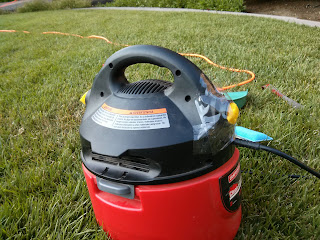
I had another sponge to use after I was done vacuuming - you remove the hose then stuff the sponge in the hole so the bees don't escape. I tested out my contraption on two "dummy bees" first (little balls of crumpled paper), the suction power was much diminished, but it still sucked them up. When I tried it out on the actual bees, it wasn't strong enough. When I was right on top of the bees, it really only lifted them off the fence a little, but their feet stayed on the fence. I found an airier sponge to use, and that increased the suction enough to remove the bees from the fence. I had to hold the hose right on top of the bee - so it was still a very weak pull so as not to harm the bees. Here is my modified contraption with a yellow sponge:
I tried this out on about 20 test subjects, then opened the container. They made it! They were a little confused, and dusty because I didn't do a great job cleaning out the shop vac, but they seem to be alive and healthy. I vacuumed up the rest of the bees right around dusk, I chose dusk so that the foraging bees would return and land on the fence - this will maximize the number of bees I can vacuum up and move off of the fence. I did this in two passes, first I vacuumed up the bees on the fence. There were still a bunch of airborne bees after that, but I was at least able to scrape all of the wax off of the fence now. I also dowsed the fence in Honey Bandit (an all natural bee repellent, it does no harm to the bees. I've used it for harvesting honey before, but this seemed like another good opportunity to use it). The airborne bees wouldn't land on the fence after I sprayed the Honey Bandit there, so they clustered on the ground as it started to get a little darker. When there were no more bees in the air, I vacuumed up the little cluster of bees on the ground. I managed to get every single bee off of the ground and off of the fence! YES! Finally some progress.

Right as it was starting to get dark, I opened the beevac and placed it right next to the opening of the hive. In the morning as the bees warm up, I hope they just go into the hive rather than return to the fence:

Attempt 1: Leave the hive near the site of the wild hive so that the bees in the old location can smell the bees in the new location. In hind site, I should have left the hive close to the wild hive site a little longer, I only left the hive near the old location for 18 hours. I've heard that the bees could take up to 2 days to relocate.
Here is what the bees looked like on Thursday afternoon, the day after we removed the hive from the fence and after my "attempt 1" at picking up the stragglers:

There was also a small cluster on the ground:

Attempt 2: brush the bees off the fence to try to clean away residual wax. The wax holds the smell that the bees are attracted to, by removing it, the bees may just leave. I think the "brushing" part of this attempt really only riled the bees up and didn't really encourage them to leave at all. I wasn't able to clean too much wax off of the fence either.
Attempt 3: Cover the area of the fence with the wax until the bees leave, then clean the wax off. I don't think my covering was properly attached to the fence, so the bees wiggled underneath.
Four days after the initial removal of the hive from the fence, the number of stragglers didn't seem to dwindle too much. If anything, they sort of just moved upwards into the vine plant, the bees on the ground also remained:

Attempt 4: Homemade bee vacuum! Okay, there is such thing as a vacuum that you use on bees. It's expensive. There are a bunch of forums that show you how to make your own out of a shop vac. Here is my attempt using a 2 gallon wet/dry vac. It seems like the main takeaway is, cover the filter and the exhaust. I covered the center cylinder containing the float ball with a towel, then put the filter on top and secured everything with a rubber band. I stuffed a kitchen sponge into the exhaust (yes, I know, very scientific procedure here):

Assembled, my beevac looks like this:

I had another sponge to use after I was done vacuuming - you remove the hose then stuff the sponge in the hole so the bees don't escape. I tested out my contraption on two "dummy bees" first (little balls of crumpled paper), the suction power was much diminished, but it still sucked them up. When I tried it out on the actual bees, it wasn't strong enough. When I was right on top of the bees, it really only lifted them off the fence a little, but their feet stayed on the fence. I found an airier sponge to use, and that increased the suction enough to remove the bees from the fence. I had to hold the hose right on top of the bee - so it was still a very weak pull so as not to harm the bees. Here is my modified contraption with a yellow sponge:

I tried this out on about 20 test subjects, then opened the container. They made it! They were a little confused, and dusty because I didn't do a great job cleaning out the shop vac, but they seem to be alive and healthy. I vacuumed up the rest of the bees right around dusk, I chose dusk so that the foraging bees would return and land on the fence - this will maximize the number of bees I can vacuum up and move off of the fence. I did this in two passes, first I vacuumed up the bees on the fence. There were still a bunch of airborne bees after that, but I was at least able to scrape all of the wax off of the fence now. I also dowsed the fence in Honey Bandit (an all natural bee repellent, it does no harm to the bees. I've used it for harvesting honey before, but this seemed like another good opportunity to use it). The airborne bees wouldn't land on the fence after I sprayed the Honey Bandit there, so they clustered on the ground as it started to get a little darker. When there were no more bees in the air, I vacuumed up the little cluster of bees on the ground. I managed to get every single bee off of the ground and off of the fence! YES! Finally some progress.

Right as it was starting to get dark, I opened the beevac and placed it right next to the opening of the hive. In the morning as the bees warm up, I hope they just go into the hive rather than return to the fence:

Subscribe to:
Posts (Atom)