Showing posts with label swarm. Show all posts

Thursday, April 3, 2014

Drone Culling, Orientation Flights, and Split Update

Tonight I attended a Beekeepers' Guild of San Mateo monthly meeting where Serge Labesque was speaking. Serge is a great speaker, and even though I've been beekeeping for 3+ years now, I always learn so much whenever I attend his lectures.

On March 30th, I noticed that there were dead drones and drone larvae in front of the green (Mint) hive:

This was only in front of the Mint hive, none of the others... I wasn't sure what to think because there were no real signs of illness. During Serge's talk, he mentioned that during times of derth (little to no honey flow), the bees will kill the drones. We've been experiencing a drought over the past few years, this year is looking even worse than last year. I harvested the most honey from this hive a little over a week ago, so perhaps I created a food shortage for this hive.

Another thing that I was a little alarmed by was the unusually high activity in the afternoon:

It's not a very long video, nor is it very close (because of the high activity). I put on my suit and also snapped a few pictures:


Serge said that this sort of activity could be an "Orientation Flight", when young bees go outside and hover. This is how they get their bearings before going out into the world.

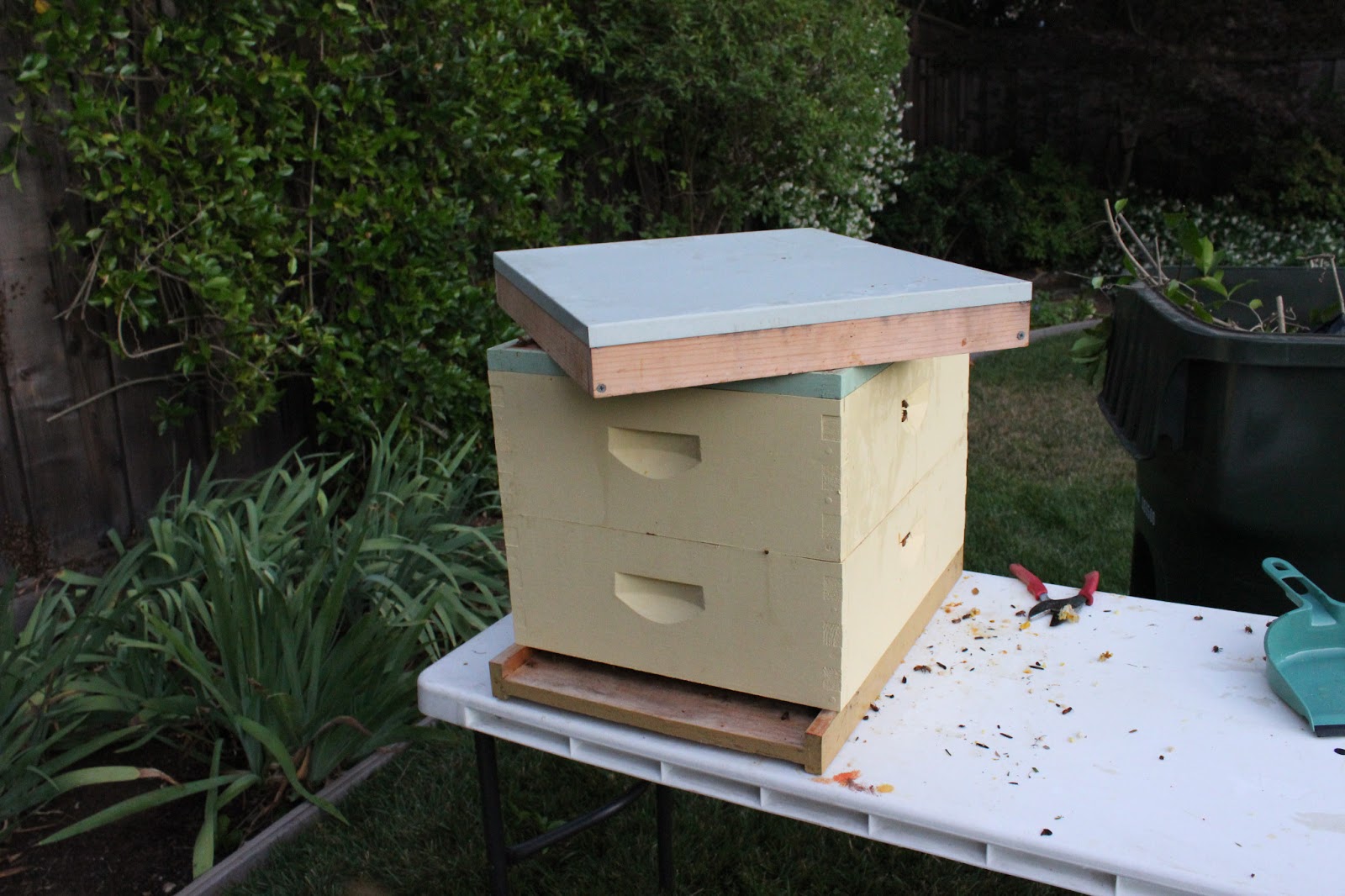
My last update is about the split. I think I may have done it a little wrong. I should have taken about 50% of the brood/bees from the yellow hive and moved it into the new hive. This will trick them into thinking that they swarmed. I moved 25% of the brood and bees at best. I also should have checked in at the 4-6 day mark to check that the new hive was building queen cells. Right now I'm at about the 12 day mark. At 16 days, the new queen will hatch. I should probably wait 2 more weeks before checking on the new hive.


Saturday, March 22, 2014

Honey Harvest and Splits!

Today we had some folks come over to help us harvest honey! We were only able to snag 11 full frames, but the yield was fantastic: 23 pounds of honey! I was expecting to get about 40 frames harvested, but with all of the recent activity we weren't able to take quite as much as expected. 

Here is the result - pretty dark since we mostly harvested honey that had been in the hive through winter, you can see that there is some spring honey towards the bottom of the jar (it's much lighter):

Here is happy helper, Cara, uncapping some fresh spring honey:

Thistle (purple hive) recently swarmed, so the honey supers were mostly emptied. We got about 4 good frames of honey harvested from Thistle.

Mint (green hive) didn't yield quite as much honey because there was a lot of brood mixed into they honey supers. I haven't been using queen excluders, and it hasn't really been a problem until now. I put a queen excluder on both Thistle and Mint. We got 6 good frames from Mint. Here is happy helper, Evan, taking a look at one of the frames we found in the supers in Mint (you can see that the center is filled with brood, the edges have beautiful capped honey from spring):

On the bright side of having a lot of brood in the supers: we got to see some baby bees hatching! This was definitely a highlight for folks (she is in the middle of the picture, just starting to chew through the wax capping of her cell):

Buttercup (yellow hive) didn't have an escape board on it (one of the boards that drains the bees from the honey supers and had similar issues with brood mixed in with the honey. I took 1 frame of honey from them but then left them the rest.

I figured that Buttercup had the highest likelihood of swarming at this point (having come from a swarm last year and coming out of the winter as one of the stronger, well-balanced hives). So I attempted to do a split. I took frames with eggs, pollen, nectar, honey, larvae, and capped brood and transferred them into a fourth hive (about 5 frames total). There were no queen cells, so I hope that the bees will be able to select an egg to raise into an emergency queen, we'll see in the next 16 days or so what happens (it takes a queen 16 days to hatch from the day it was laid). Here is happy helper, Wyatt, helping select frames to put into the new hive:

Sunday, June 30, 2013

Stragglers

The bees that we moved off of the fence the other day seem to like their new hive, they don't seem to want to return to the fence. However not ALL of the bees made the move. There is about a grapefruit sized cluster of bees that refuses to leave the fence! I think I finally got them today though (after many failed attempts).

Attempt 1: Leave the hive near the site of the wild hive so that the bees in the old location can smell the bees in the new location. In hind site, I should have left the hive close to the wild hive site a little longer, I only left the hive near the old location for 18 hours. I've heard that the bees could take up to 2 days to relocate.

Here is what the bees looked like on Thursday afternoon, the day after we removed the hive from the fence and after my "attempt 1" at picking up the stragglers:


There was also a small cluster on the ground:


Attempt 2: brush the bees off the fence to try to clean away residual wax. The wax holds the smell that the bees are attracted to, by removing it, the bees may just leave. I think the "brushing" part of this attempt really only riled the bees up and didn't really encourage them to leave at all. I wasn't able to clean too much wax off of the fence either.

Attempt 3: Cover the area of the fence with the wax until the bees leave, then clean the wax off. I don't think my covering was properly attached to the fence, so the bees wiggled underneath.

Four days after the initial removal of the hive from the fence, the number of stragglers didn't seem to dwindle too much. If anything, they sort of just moved upwards into the vine plant, the bees on the ground also remained:

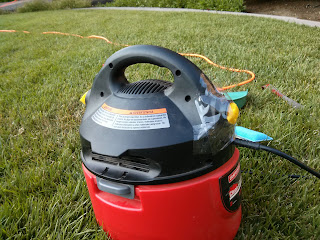
Attempt 4: Homemade bee vacuum! Okay, there is such thing as a vacuum that you use on bees. It's expensive. There are a bunch of forums that show you how to make your own out of a shop vac. Here is my attempt using a 2 gallon wet/dry vac. It seems like the main takeaway is, cover the filter and the exhaust. I covered the center cylinder containing the float ball with a towel, then put the filter on top and secured everything with a rubber band. I stuffed a kitchen sponge into the exhaust (yes, I know, very scientific procedure here):

Assembled, my beevac looks like this:

I had another sponge to use after I was done vacuuming - you remove the hose then stuff the sponge in the hole so the bees don't escape. I tested out my contraption on two "dummy bees" first (little balls of crumpled paper), the suction power was much diminished, but it still sucked them up. When I tried it out on the actual bees, it wasn't strong enough. When I was right on top of the bees, it really only lifted them off the fence a little, but their feet stayed on the fence. I found an airier sponge to use, and that increased the suction enough to remove the bees from the fence. I had to hold the hose right on top of the bee - so it was still a very weak pull so as not to harm the bees. Here is my modified contraption with a yellow sponge:
I tried this out on about 20 test subjects, then opened the container. They made it! They were a little confused, and dusty because I didn't do a great job cleaning out the shop vac, but they seem to be alive and healthy. I vacuumed up the rest of the bees right around dusk, I chose dusk so that the foraging bees would return and land on the fence - this will maximize the number of bees I can vacuum up and move off of the fence. I did this in two passes, first I vacuumed up the bees on the fence. There were still a bunch of airborne bees after that, but I was at least able to scrape all of the wax off of the fence now. I also dowsed the fence in Honey Bandit (an all natural bee repellent, it does no harm to the bees. I've used it for harvesting honey before, but this seemed like another good opportunity to use it). The airborne bees wouldn't land on the fence after I sprayed the Honey Bandit there, so they clustered on the ground as it started to get a little darker. When there were no more bees in the air, I vacuumed up the little cluster of bees on the ground. I managed to get every single bee off of the ground and off of the fence! YES! Finally some progress.

Right as it was starting to get dark, I opened the beevac and placed it right next to the opening of the hive. In the morning as the bees warm up, I hope they just go into the hive rather than return to the fence:
 

Wednesday, June 26, 2013

Collecting the Wild Hive

I sent out an email to the San Mateo Beekeepers Guild to see if I could borrow some equipment and get some help putting the wild hive on the back fence into a wooden beehive. Thanks to Vicky for letting me borrow some of the hive components I was missing, and extra special amazing thanks to Art for helping me get the bees into their new home!

I had no idea how to get the bees off the fence into a hive, so Art was a great help. Here's how we did it:

So our plan A was to prune the bush they were hiding behind, then carefully take the comb off the fence and put it into frames. So we started out pruning the bush, the bees were extremely calm and manageable, we didn't even need to use gloves or veils:

Here is the full size of the hive once everything was trimmed. It's probably about 1 and a half feet tall and almost a foot deep as well. Looks like they have definitely been living here for about a month. We put a tarp down to catch any bees that fell:

Great! Plan A is going so well! Wait... I spoke too soon. We only had the hive fully exposed long enough to put up the tarp and snap that last picture. Then this happened:
 

Not sure what that is? The entire hive fell off of the fence at once. When it hit the ground, bees flew everywhere. It was literally an explosion of bees. It probably happened for a few reasons, the hive was probably partially supported by all those branches we cut away, the sun was setting and shining directly on the hive (which warmed the wax enough to melt the connection to the fence), and the hive had a surprising amount of honey in it (making it quite heavy).

Ok, plan B: scoop up the bees and put them into a hive, also pray that the queen didn't get crushed to death. Here is how we put the pieces of comb into frames, you cut chunks of the hive to the right size and then tie them in with cotton string. Once in the hive for a few days, the bees will patch up the comb and attach it to the frame:

We managed to salvage about 5 frames of comb (if plan A had worked out, we were expecting to get 10+ frames). We did need to check through all the little bits of comb to make sure we didn't miss the queen. here is Art shaking some bees into their new home:

After we were done, we filled up the box with frames that had foundation on them and then put another medium on top. We left the cover askew so that the scent of the queen would attract the stray bees left on the lawn and fence:

It was a really good sign that the bees at the top of the hive and around the entrance were "fanning". Fanning is when they stick their butts in the air and fan their wings. I've seen bees doing this when the hive is hot - then they are doing it for ventilation. However, in this case the bees are doing it to fan the scent of the queen out around the new home. This means that the bees think the queen is in residence inside the new yellow hive:

We made sure to remove as much of the scent from the fence location as possible. There were little nubs of wax on the branches, Art said these were "scent tabs". Essentially little bits of wax that smell like the queen to attract bees that got a little lost in the swarming process. We left the hive near the fence location so the bees would go to the new hive rather than cling right back to the fence. Here are the "scent tabs":

I'll check back in on these guys in a week or so to remove all that string and make sure they are liking their new home :) Luckily there were plenty of eggs in the comb we put in the hive, so if the queen was lost in the fall, they should be able to make a new one. Hopefully the fanning means we got her in there though.

Sunday, June 23, 2013

Lost and Found

So I lost half my Thistle hive to swarming, not to mention a very good and productive queen. However, I didn't lose them for long! I found them! They were hiding in this bush about 30 feet from the original hive! This is actually right where my neighbor noticed the high bee activity. Brandon is pointing out the swarm's hiding spot:

Oh? You don't see them? How about now?
  

Still don't see the bees? Try again:

Here they are!

I estimate there is about 1 deep super full of comb built onto the fence. This is no longer a swarm since the bees have started building comb. I guess my swarm left, found this fence and decided to stay! Lucky me! Now I'll just grab them and make that third hive I was talking about :)

Swarm Confirmation and Supersedure

Well, I think I've got a confirmation that the Thistle hive swarmed. Earlier this week I was talking to our backyard neighbor, he had said there was extremely high bee activity happening on our property line around June 4th. It was only for a day, so I assume that about half of the Thistle hive took off with the queen. Usually a swarm will leave the hive and regroup within 50 feet of their hive, then they'll send out scouts to look for a permanent location. I assume my bees hung out around the fence and then moved on.

A new queen only takes about 16 days to hatch, since I saw queen cells around the end of May, I figured it was ok to take a peek inside of the Thistle hive to see if she had started laying eggs yet. If she hasn't it's no big deal, it's still early. A new queen hatches, then kills any other younger queens that didn't hatch (eliminating the competition). After that she goes on a mating flight where she mates with several drones, then she returns to the hive to start laying eggs. That whole process is probably not complete quite yet.

Inside of the Thistle hive, there were a lot of empty cells and a lot of capped brood. No larvae and no eggs. Worker bee larvae gets capped with wax around 9 days after a queen lays an egg, then hatches 21 days after the egg has been laid. That means that the queen must have been in the hive between June 2nd and June 14th, but then she left - so our neighbors account of a ton of bees swarming on the 4th lines up exactly with what is happening inside the hive. I actually didn't see any queen cells, but perhaps the bees have cleaned them up by now. I'll check for eggs in the next few weeks just to make sure everything is going well with the new queen.

Now to the Mint hive - there has been extremely low activity in front of the Mint hive. During the middle of the day, when there should be peak activity in front of the hive, there are only 2 or 3 bees coming in or out of the hive:

The Thisle hive, even after swarming, looks more like this (these pictures were both taken within minutes of each other):

So something definitely seems wrong with the Mint hive. When I opened up the hive, there were extremely few bees, and supersedure cells everywhere. Supersedure cells are cells used for growing queens. When a hive wants to swarm, they build swarm cells - also used for growing queens. The only difference between the two is that swarm cells are usually built along the bottom of the frame, the existing queen will take half the bees and leave, and a queen that hatches from a swarm cell will take over. Supersedure cells are built all over the frame and are used to replace a failing or non-existent queen, when the new queens hatch they will kill the old queen. The long cells are supersedure cells that have hatched (well, only one of them hatched, then that queen went around to all the un-hatched cells, opened them, and "took care" of the competition):

So it looks like either A) The Mint bees didn't like their queen and replaced her, or B) The Mint queen died and they replaced her. Apparently this is quite common with packages (Mint was a new package this spring). On the bright side, I saw one frame that had about 1/4 of the cells filled with eggs and 1/4 of the cells filled with larvae - so it would seem that there is currently a queen in residence.

Monday, May 27, 2013

Queen Cups

When we were taking the frames of honey to harvest off of Thistle, we found two frames of brood and A LOT of queen cups. None of them seemed to have any eggs in them, but that is probably because these frames were above the bee escape. One of them had some white waxy looking substance in it, I think it may be royal jelly, though it looks a lot more solid than I thought royal jelly would:


I suspect the bees are preparing to swarm - meaning the existing queen is preparing to leave with a large portion of the bees in the hive. They've run out of space and want to find a new home. The bees that remain in the hive would raise a new queen in one of these queen cups.

This would be the perfect time to split the hive. Splitting is essentially me swarming for the bees. Since Thistle feels like it is out of space, I would split it's resources in half and create two hives. Unfortunately I don't have the resources or time to perform a split right now. Though I have been preparing to split Thistle into a new yellow hive, I still don't have an extra bottom board or inner cover - so I have no where for a new hive to go. This means I'll probably end up losing my queen, which is too bad since she is obviously doing an amazing job since her hive is so strong.