Saturday, March 31, 2012

Package Installation

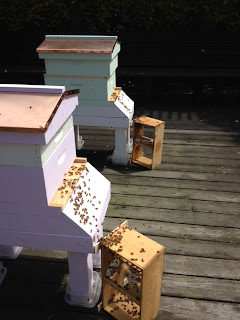
Vicky and Elizabeth installed my packages today and sent me this picture! The packages (that the bees came in) are in front of the hives because there are still a few stranglers:

Thursday, March 29, 2012

Getting Ready for the Girls

The two packages of bees that I ordered from the Beekeepers Guild of San Mateo County are coming this weekend! Unfortunately I'll be in Seattle, but a friend of mine said she'd install my packages for me (thanks Vicky!). So I'm preparing my hives so they'll be ready for this weekend. I had 10 frames of wired wax leftover from last year that I am putting into the bottom brood boxes of the new hives. I marked them with Xs because I've heard that the wax only foundation doesn't go into honey extractors very well (also why I'm putting them in the bottom boxes, so they'll be used for brood, not honey).

Here is what a wired wax frame looks like, the foundation is only wax and it is held up by a few wires:

Here is what my other frames look like, they have duragilt foundation in them (which has a thin piece of plastic that is coated in wax, it also has a metal binding down the sides):

 After putting all of the frames in the hive bodies, I put one medium hive body on each and placed them outside in their new location on the deck. The new location is much sunnier than last year (in the side yard where the bees really only got early morning sun).

I also got a new deck box to store my bee equipment in. I put my tools, some feeders, and some extra hive bodies in there:

Tuesday, March 13, 2012

Bee Building

Spent a few nights at mom's house assembling the hive bodies and frames. I chose some more interesting colors for the hives this year ("mint" and "thistle"). The frames are stacked to the side of the hives because the wood glue is still drying and I didn't want them to get stuck inside the hive bodies. I forgot the drill so I couldn't put together the hive stands, but I'll do that next time:

Sunday, March 11, 2012

Ramp Up

It's been a while! There is usually a lull in activity over the winter, but there has been an extra large lull for me since there were no bees. However, now I am starting to ramp back up for spring, starting with some brand new beequipment! This year I decided to go with Brushy Mountain Bee Farm for my hive equipment. A friend of mine in Seattle used their hive equipment, and I really liked how cute the hive tops were.

Brushy Mountain Bee Farm is actually based in North Carolina (I know, I know, I'm nuts. There are plenty of local suppliers). To to cut down shipping costs I bought most of my supplies un-assembled. Here are all of the parts that I need to assemble and paint in the next few weeks (this is 7 medium hive bodies and the 70 frames to go in them):


I got these items fully assembled:
  • Copper Hive Top (much cuter than my previous telescoping top)
  • Top Board with another entrance (not sure if I'll use the other entrance because I use hive top feeders - the bees wouldn't be able to enter from the top entrance if the feeder is on).
  • Screened Bottom Board (this will help me monitor the mite population)
  • Hive Top Feeder (I needed another one for my second hive. This is the Brushy Mountain version of my Mann Lake feeder - you need to place a hive body over it. At first glance I like my Mann Lake feeder better, but we'll see how well it works before I make a final judgment).

Monday, November 7, 2011

Beekeepers Guild Meeting

I finally attended a meeting with the Santa Clara Valley Beekeepers Guild meeting, I've been meaning to go for a while. There were some really good presentations on how to make mead, lotion, soap, and candles. I really liked it and everyone was really friendly so I joined the guild.

I also asked some folks there what they thought about what happened to my bees. Here were their thoughts:
  1. Too much Apiguard -  if the bees are dosed with too much Apiguard, it can kill them just as easily as a pesticide. When the temperatures are too hot (100 degrees Fahrenheit +) you should reduce the amount of Apiguard that you are using. I also found out that a lot of people halve the amount of Apiguard they apply to the hive anyway. I think that it is unlikely that I applied too much Apiguard because the temperatures were in the 70s, I was following the label instructions, and when I opened the hive I couldn't smell/see any Apiguard when I opened the hive.
  2. Varroa Mites - the population of Varroa Mites peaks after the population of the bees peaks, so as the bees are preparing for winter, there are way more mites. I may have treated the bees too late in the season and the mites would have had time to overtake the bees. I also doubt that this is what happened. Some of the folks at the meeting said that the wings are a dead giveaway, if the wings are very tiny and curled up, it's a sign that there are a lot of mites. Looking at the pictures of my bees, they look absolutely fine other than their behavior. I'll look more carefully next time I am at the hive.
  3. Poison - There were recently a few cases of vandalism in Saratoga where people sprayed poison onto bee hives. Since my bees are behind a gate, I doubt my bees were victims of vandalism. I sent an email to our gardener to double check that he didn't spray anything in the yard (I really doubt he did anything, since he gardens for a few other folks with bees). There is also a lot of new landscaping around Los Altos because of all of the renovations in downtown, so it is possible that the city is just spraying their plants (and that is what my bees were into).
Of all of the theories, I still think that it was most likely pesticide. There is another meeting in December, some of the members suggested that I bring in one of my worst frames so that they can take a look.

Saturday, October 29, 2011

The Queen is Dead

Well, after 5 months of having a hive - game over. I found the queen. Dead. Outside the hive. (In this photo she is in a little dish that I picked her up and put her in there so she wouldn't be lost in the mass grave that is our side yard).

I think I actually exhibited a very fast-forwarded version of the 5-step grief process:

1 - Denial: When I found a bee with a white dot on it on the ground I looked at it and thought that it was not the queen. That was probably someone else's bee, it was too small to be my queen (the bees look so much tinier when they are dead, she looked the size of a normal bee, not a queen). So what if she had a white dot on her, maybe someone was just running around painting my bees for fun.

2 - Anger: Why my bees? I was taking such good care of them... I actually stomped down to the empty lot on Alvarado Ave because I had heard that round-up could be especially bad for the bees. I swear there were some dead plants there.

3 - Bargaining: Maybe if I just feed them, they'll be fine and make a new queen. I called Cheryl at Bear Foot Honey to see if there was ANY chance of me re-queening (even though I knew the answer would no). It is too late in the season for me to re-queen the hive myself, and it is too late in the season for the bees to create their own queen. At the beginning of winter, the worker bees (all girls) kick all of the drones (boys) out of the hive. The boy bees are useless during winter and they just take up space and eat food. The girls just make some new boys in the spring. It is more than likely that the girls have already kicked the drones out, so if they made their own queen, she wouldn't be able to mate and would be useless anyway.

4 - Depression: :(

5 - Acceptance: Ok, I lost my one and only hive this year. On the bright side, it looks like I could perhaps reuse my equipment (hive and frames) next year (since they didn't die of disease). Cheryl said that I should leave the equipment out for 30 days to make sure that the pesticide had dissipated, then I should freeze my frames to kill off any fungus or wax moth larvae (since the pollen is not completely unprotected and vulnerable). Brandon agreed that I could have 2 hives next year (I think mostly just because he doesn't want me to be sad any more right now). Next step: convince Mom that 2 hives is a good idea :)
Chilled Brood

Got to Mom's house early this morning and peaked out at the hive. There were a lot more dead bees, and there was one chilled brood near the entrance of the hive (the white thing is a dead developing bee that has been removed from the hive by the bees):

Chilled brood is when the developing bee larvae are too cold and die (or are deformed). This can happen as a result of the beekeeper opening the hive when it is too cold or as a result of severely decreased numbers of bees (from pesticide poisoning because there are not enough bees in the hive to keep all of the brood warm).

I've fixed up some more food for the bees (a 2:1 sugar to water ration that is more like honey than their spring and summer mix which is only 1:1). Hopefully this will help them out a little so they can make it through winter.

I'm also going to wrap the hive in tar paper today hive today to try to keep them warmer (this is a normal winterizing step - the black paper will help warm up the hive as well as protect the bees from the wind creeping in to little holes).