Friday, August 17, 2012
Dancing Bees?
I was taking a look at the bees today, it was another very hot summer day so there were a lot of bees bearding around the front of the hive. There were a lot more around the entrance of the Mint hive. The bees on the front porch seemed to be fanning to cool the hive down, but I'm not sure what these bees on the side are doing (rapidly moving their front legs). Dancing perhaps?

Sunday, July 29, 2012
Name that Honey
We need a name for our honey! Do you have any ideas? Please comment on this post with name ideas (or email me - most people that read this blog are my friends and family - so you most likely have my email address already). Here is what the finished product looks like:


So far here are the two that I like the best:
Sweet Bees Honey
Side Yard Honey


So far here are the two that I like the best:
Sweet Bees Honey
- There are slight variations of this everywhere
- Picture two or three round bees in a pea pod :) sweet bees!
Side Yard Honey
- Because last year we started out with our bee yard in the side yard of Mom's house
Sunday, July 22, 2012
Honey Harvest
Finally! Our first honey extraction! There is a brief video of the whole process at the bottom of this post.
The first step we took in preparing to harvest our honey was to get a honey extractor. Since Brandon and I are members of the Beekeepers' Guild of San Mateo, we were able to borrow an extractor and a few other tools from them.
Next, we had to get all of the bees out of the honey supers so that we could take the honey away. I got two triangle escape boards from Brushy Mountain Bee Farm. The escape board goes between the brood boxes and the honey supers - the bees can move down into the brood boxes, but then they can't figure out how to get back up into the honey supers. On Friday afternoon, we put bee escapes on both hives. Here is a picture of the escape board on the Thistle hive (the bees go down through the hole and can't come back up):

We had two honey supers above the bee escapes on each hive (the un-painted wood that you see is the escape board):

On Saturday afternoon, we came back to the hives to take the honey away. We probably should have put the escape boards on 48 hours in advance, but we only managed to get them on 24 hours in advance. Despite that, there were very few bees in the top of the Thistle hive, maybe 20 bees on each frame - so we just brushed them off and took the honey. There were many more bees in the Mint hive - but they had a lot more uncapped honey. I was reading the Honey Handbook that Dad and Pauline got me for my birthday the night before, and it said not to take uncapped honey unless you had a way to measure the water content, otherwise the honey may ferment. I ended up leaving a lot of the honey on the hive because one or both sides had quite a lot of uncapped honey. Overall, out of the 40 frames that I was hoping to harvest, we were only able to harvest 9.
Now for the fun part! Extracting the honey from the frames. First we used a heated knife to scrape off the cappings (the bees seal the honey, so we open it up). We cut the cappings over a special bucket that has an upper tray and spigot in the bottom, the cappings stay in the top tray while the honey drips down below. When we're all done, we get a little extra honey out of the bucket. Then we put the frame into an extractor, which is a centrifuge to spin the honey out of the comb. Here is our whole operation, complete with Brandon spinning frames in the extractor:

The whole cutting and spinning process took a little getting used to. First of all, we probably destroyed a ton of comb just trying to uncap the frames - I think we were trying to cut too fast or the knife wasn't hot enough. Then, the frames we didn't destroy in the uncapping process, we finished off in the spinning process. The honey was so heavy that when we were spinning one side of the frames, the honey on the inside caused the frame to collapse towards the outside. We probably should have spun slowly on one side, then switched to the other side to keep the comb from collapsing.
After spinning the frames, we open the spigot at the bottom of the extractor. The honey drips down through a coarse filter and a fine filter (the fine filter is only 200 microns, so this process takes the whole night):

Once we've filtered out all the little wax particles, we ended up with about 1/3 of a 5 gallon bucket of nice clear honey. I had bought a few different sizes of honey bottle, here is me filling up a 3 pound bottle (I look kind of like a crazy person because I turned just long enough to snap a picture, I am trying not to spill honey everywhere - which did happen a few times throughout the bottling process):

Overall, we got 22 pounds of honey (two small bottles are not pictured here), which is pretty good for the number of frames we harvested. Since this is the first year, and these are brand new bees - this is about 1/4 of the amount of honey we expect to harvest next year. Here are all of the bottles we got this time (the small ones are 1/2 pound jars, the large ones are 3 pound jars):

Now we just need a name for our honey and a label :)
And here is the video, as promised:
The first step we took in preparing to harvest our honey was to get a honey extractor. Since Brandon and I are members of the Beekeepers' Guild of San Mateo, we were able to borrow an extractor and a few other tools from them.
Next, we had to get all of the bees out of the honey supers so that we could take the honey away. I got two triangle escape boards from Brushy Mountain Bee Farm. The escape board goes between the brood boxes and the honey supers - the bees can move down into the brood boxes, but then they can't figure out how to get back up into the honey supers. On Friday afternoon, we put bee escapes on both hives. Here is a picture of the escape board on the Thistle hive (the bees go down through the hole and can't come back up):

We had two honey supers above the bee escapes on each hive (the un-painted wood that you see is the escape board):

On Saturday afternoon, we came back to the hives to take the honey away. We probably should have put the escape boards on 48 hours in advance, but we only managed to get them on 24 hours in advance. Despite that, there were very few bees in the top of the Thistle hive, maybe 20 bees on each frame - so we just brushed them off and took the honey. There were many more bees in the Mint hive - but they had a lot more uncapped honey. I was reading the Honey Handbook that Dad and Pauline got me for my birthday the night before, and it said not to take uncapped honey unless you had a way to measure the water content, otherwise the honey may ferment. I ended up leaving a lot of the honey on the hive because one or both sides had quite a lot of uncapped honey. Overall, out of the 40 frames that I was hoping to harvest, we were only able to harvest 9.
Now for the fun part! Extracting the honey from the frames. First we used a heated knife to scrape off the cappings (the bees seal the honey, so we open it up). We cut the cappings over a special bucket that has an upper tray and spigot in the bottom, the cappings stay in the top tray while the honey drips down below. When we're all done, we get a little extra honey out of the bucket. Then we put the frame into an extractor, which is a centrifuge to spin the honey out of the comb. Here is our whole operation, complete with Brandon spinning frames in the extractor:

The whole cutting and spinning process took a little getting used to. First of all, we probably destroyed a ton of comb just trying to uncap the frames - I think we were trying to cut too fast or the knife wasn't hot enough. Then, the frames we didn't destroy in the uncapping process, we finished off in the spinning process. The honey was so heavy that when we were spinning one side of the frames, the honey on the inside caused the frame to collapse towards the outside. We probably should have spun slowly on one side, then switched to the other side to keep the comb from collapsing.
After spinning the frames, we open the spigot at the bottom of the extractor. The honey drips down through a coarse filter and a fine filter (the fine filter is only 200 microns, so this process takes the whole night):

Once we've filtered out all the little wax particles, we ended up with about 1/3 of a 5 gallon bucket of nice clear honey. I had bought a few different sizes of honey bottle, here is me filling up a 3 pound bottle (I look kind of like a crazy person because I turned just long enough to snap a picture, I am trying not to spill honey everywhere - which did happen a few times throughout the bottling process):

Overall, we got 22 pounds of honey (two small bottles are not pictured here), which is pretty good for the number of frames we harvested. Since this is the first year, and these are brand new bees - this is about 1/4 of the amount of honey we expect to harvest next year. Here are all of the bottles we got this time (the small ones are 1/2 pound jars, the large ones are 3 pound jars):

Now we just need a name for our honey and a label :)
And here is the video, as promised:
Sunday, June 24, 2012
Queen Exile
I wanted to do one last thorough inspection before going out of town for the next few weekends. Thistle was looking pretty good, there was a lot of capped honey in the top super:

There were also a few crazy pieces, here is one where the bees had capped honey underneath, and another layer on top:

When I did Mint's inspection, they were not doing quite as well. When I started looking at the frames in the top super, there was a ton of brood! There should have been absolutely no brood because I was using a queen excluder - so that means that I accidentally trapped the queen in the top 25% of the hive that had mostly foundation without drawn comb on it. The bottom 75% was almost completely filled with honey, I saw a bit of what looked like drone brood, and there were a ton of drones wandering around the hive. Usually, when you trap the queen in the honey supers, the bees start to see her as weak because she is not producing enough brood - so they would either make a new queen, or a worker would start laying (worker bees can only lay drones). I only had the queen excluder on for 3 weeks, I didn't see any evidence that the bees had tried to replace the queen, so I just put the top box on in the middle and moved the bottom boxes filled with honey up to the top. Hopefully I didn't screw things up too badly...
Since both hives seemed to be pretty full - I put on another box, making the hives just about as tall as I was:


There were also a few crazy pieces, here is one where the bees had capped honey underneath, and another layer on top:

When I did Mint's inspection, they were not doing quite as well. When I started looking at the frames in the top super, there was a ton of brood! There should have been absolutely no brood because I was using a queen excluder - so that means that I accidentally trapped the queen in the top 25% of the hive that had mostly foundation without drawn comb on it. The bottom 75% was almost completely filled with honey, I saw a bit of what looked like drone brood, and there were a ton of drones wandering around the hive. Usually, when you trap the queen in the honey supers, the bees start to see her as weak because she is not producing enough brood - so they would either make a new queen, or a worker would start laying (worker bees can only lay drones). I only had the queen excluder on for 3 weeks, I didn't see any evidence that the bees had tried to replace the queen, so I just put the top box on in the middle and moved the bottom boxes filled with honey up to the top. Hopefully I didn't screw things up too badly...
Since both hives seemed to be pretty full - I put on another box, making the hives just about as tall as I was:

Sunday, June 17, 2012
Hot Bees
I did a double check today to make sure that the bees were making it up through the queen excluders, I only took a quick peek, but there seems to be a lot of activity up there. I didn't want to do a full inspection because it has been so hot recently (90+ degrees) so instead I just gave the bees some extra water (in their bucket) and planted 3 sunflowers for them (right in front of the bench):

There has also been a lot of activity in front of the hives lately, the bees are probably just trying to spend a little bit more time on the porch to cool down:

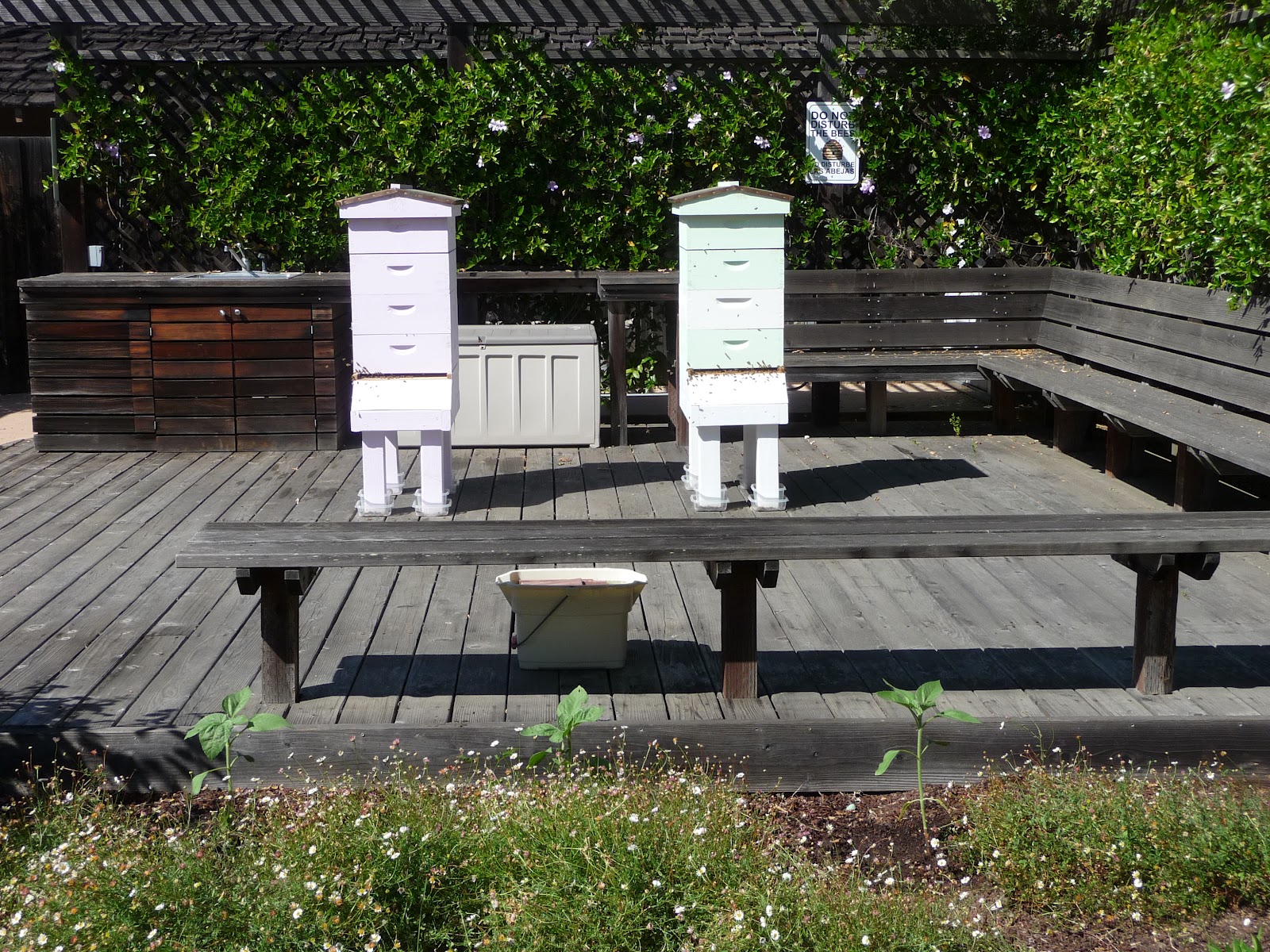
There has also been a lot of activity in front of the hives lately, the bees are probably just trying to spend a little bit more time on the porch to cool down:

Sunday, May 20, 2012
Sneak Peek: Honey!
I went out to do a thorough hive inspection today. I have been a little concerned about the bees because they seem to bunch around the opening after inspections, so I was thinking that they were maybe too crowded in just two medium boxes. A bunch of the folks I know in the San Mateo Bee Guild attended a class where the instructor suggested putting a new box on the bottom instead of the top so that the returning foraging bees have more space to come inside. So I put one more brood box on each hive - I put Thistle's on the bottom and Mint's on the top just to see if it made any difference (looks like it didn't):

I also put a top entrance on Thistle so they have more places to enter the hive (you can see them clustering around a small hole at the top, that's their new entrance).
Mint also built a lot of burr comb up in their feeder, so I took that out. It was filled up with nectar and honey, so I decided to try to bottle it. Here is the smashed honey comb with honey in my filter, the honey is dripping down through the filter into a cup, leaving all the wax and gunk out:

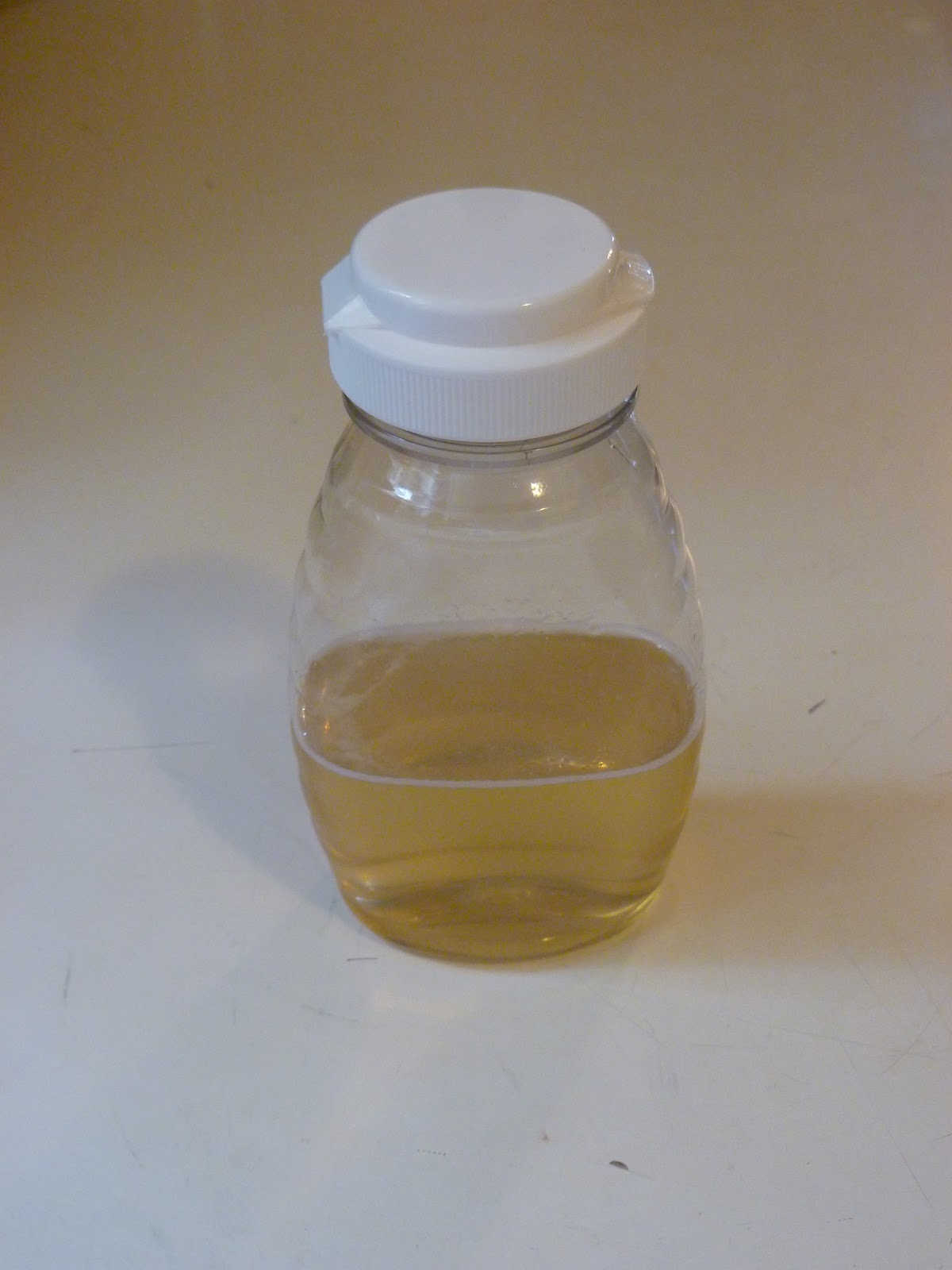
And here is the final product! Honey! It is very light in color because it probably has very high water content. The bees put nectar into the comb and fan it to evaporate the water. When the honey has the right water content, the bees cap the honey comb. Most of the honey that I took was uncapped, so it probably has more water than it should, it is still delicious though (this is about 1/2 cup of honey):


I also put a top entrance on Thistle so they have more places to enter the hive (you can see them clustering around a small hole at the top, that's their new entrance).
Mint also built a lot of burr comb up in their feeder, so I took that out. It was filled up with nectar and honey, so I decided to try to bottle it. Here is the smashed honey comb with honey in my filter, the honey is dripping down through the filter into a cup, leaving all the wax and gunk out:

And here is the final product! Honey! It is very light in color because it probably has very high water content. The bees put nectar into the comb and fan it to evaporate the water. When the honey has the right water content, the bees cap the honey comb. Most of the honey that I took was uncapped, so it probably has more water than it should, it is still delicious though (this is about 1/2 cup of honey):
Saturday, May 5, 2012
Visit from Padge and Heather
Today, Padge and Heather came to see the bees. They sat on the deck while I was doing the hive inspection, but they came up close to see a few things that I was pointing out. Here I am showing Mom and Heather some eggs, nectar, and pollen:

I also finally looked at the cardboard panel beneath my screened bottom boards this time, they were covered in cruft - it looked like mostly pollen that had fallen off of the bees, chewed out wax caps, and a bunch of squirming hive beetle larvae (gross). Padge, Mom and Heather came over to take a look:

I also put on my grease patties (that I had forgotten to put on in the last inspection). These are part crisco and part sugar sandwiched in between two sheets of wax paper. It helps guard against tracheal mites (I have no idea why):

And here is a really nice shot of a drone bee (boy bee) next to a worker bee (girl bee). The drone is on the right and has a larger body and huge eyes, the worker bee is on the left.

I was hoping that I'd be able to put a honey super on the Thistle hive, but they had only drawn out about 65% of their latest hive body. The Mint hive looked like it was only about 50% drawn. I did see a bunch of eggs in both hives, so I didn't bother looking in the bottom brood box..
For this inspection, I tried using a mixture of my new smoker fuels. I put in a few handfuls of cotton and a little handful of wood pellets. I didn't have to relight my smoker at all! This is the winning mixture for me, man I wish I knew about this last year.

I also finally looked at the cardboard panel beneath my screened bottom boards this time, they were covered in cruft - it looked like mostly pollen that had fallen off of the bees, chewed out wax caps, and a bunch of squirming hive beetle larvae (gross). Padge, Mom and Heather came over to take a look:

I also put on my grease patties (that I had forgotten to put on in the last inspection). These are part crisco and part sugar sandwiched in between two sheets of wax paper. It helps guard against tracheal mites (I have no idea why):

And here is a really nice shot of a drone bee (boy bee) next to a worker bee (girl bee). The drone is on the right and has a larger body and huge eyes, the worker bee is on the left.

I was hoping that I'd be able to put a honey super on the Thistle hive, but they had only drawn out about 65% of their latest hive body. The Mint hive looked like it was only about 50% drawn. I did see a bunch of eggs in both hives, so I didn't bother looking in the bottom brood box..
For this inspection, I tried using a mixture of my new smoker fuels. I put in a few handfuls of cotton and a little handful of wood pellets. I didn't have to relight my smoker at all! This is the winning mixture for me, man I wish I knew about this last year.
Subscribe to:
Posts (Atom)